Pilgrimage festivals 1Character of the pilgrimages
Pilgrimage festivals
Original title: Romarias
Describes the popular religious pilgrimages and feast-day gatherings (romarias and arraiais) of rural Madeira: their music, dancing, fireworks, food, drink and vows, with a calendar of the main feasts and early historical references.
1Character of the pilgrimages
The country people of Madeira, generally cheerful and outgoing by nature, find in the pilgrimage festivals (romarias) one of their chief pastimes. Given over almost all year to work that demands a great expenditure of strength and energy, they seek in these amusements a way to forget the hardships of life and a few hours of delight for their spirit, which is untutored but generous and good.
At the time of the great feast-day gatherings (arraiais), numerous groups of men and women leave their homes for the places where these are held, sometimes covering great distances as they sing and dance to the sound of the machetes and violas, without showing any sign of fatigue from this rather strenuous exercise. Nor is it only the young men and women who give themselves over to such amusements: the old sometimes join in too, leaning on their staffs and improvising verses with which they beguile the weariness of the road and bring cheer to their fellow pilgrims.
It is said in Madeira ‘that the eves are better than the feasts’, and indeed it is on the day before any religious festival that the greatest joy and enthusiasm reign in the place where it is held. It is above all at night, when both the churchyard (adro) and the façade of the church are lit with coloured glasses and Venetian lanterns, that men and women give themselves up most fully to merrymaking, and that the character of popular amusements in Madeira can best be appreciated.
Although no feast-day gathering is held today without one or more brass bands, it is not the pieces they play that most hold the attention of the great majority of our country folk. Open-air songs, often sung as improvised contests, arouse far greater interest among country people. That is why the crowds are always densest and largest wherever there are young men ready to enjoy themselves and entertain others with their verses of intensely local flavour.
There are many similarities between the dances of our people and those of the black people of Africa, just as there are, and very remarkable ones, between certain songs peculiar to our countryside and Arab songs (see Music). The leaps and turns that characterise the island’s dances, often accompanied by shrieks, recall the African batuques, perhaps the chief pastime of black people on feast days when slavery existed here. The old Madeiran songs, for their part, reflect the monotony of the Arab chants so often heard with pleasure by the people in the times of colonisation.
2Fireworks, night scenes, food and drink
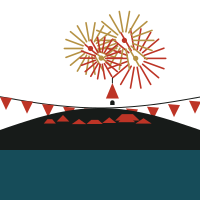
Fireworks are a draw for the great majority of Madeiran feasts, and at times very large sums are spent on shells and rockets that might well be used to help the poor or for useful works in the parish (freguesia). Madeirans of the lowest social classes are generally thrilled by the deafening noise of certain exploding shells. That is why there is always a great abundance of these fireworks at every arraial (open-air popular festival at a church feast), and why the wildest follies are committed when it comes to setting them off. Nor is it only in the countryside that people are free to disturb those who do not enjoy the crack of bombs; in Funchal too the greatest abuses are committed in letting off rockets and shells, without the authorities seeking to bring those responsible into line.
After eleven o’clock or midnight, when the musicians are resting and most of the lights have gone out for lack of fuel, the site of the arraiais offers a spectacle at once curious and burlesque. Everywhere men and women can be seen lying about, overcome by weariness or drink. Those still on their feet remain so only to carry on long and tedious arguments with their companions, or to strike up one more song in a hoarse voice to earn yet another grog or glass of wine at the nearest tavern or stall.
Knife fights and serious disorders, so frequent at the arraiais of mainland Portugal, seldom occur in Madeira. Only now and then are there scuffles in which the combatants’ weapons are staves of heath or folhado (Clethra arborea, a native tree), and these are almost always caused by the copious libations in which the pilgrims indulge.
No family visits an arraial without a basket well stocked with food for the journey, and at the site of the feast there is always plenty of meat for the so-called espetadas that our country folk so enjoy. According to those who know, the skewer on which the meat for the espetada is threaded should be of laurel, and it is also advisable to feed the fire with branches of this tree so that the meat is tastier.
The leather bottle of wine or spirit (aguardente, distilled from sugar cane or wine) is the peasant’s inseparable companion at pilgrimages; the whole family drinks from it, as do any people he wishes to treat. A small gourd has become rare which, once dried and emptied of its seeds, was formerly much used by women and children to carry the drinks indispensable for the journey.
3Vows and the calendar of feasts
Among those who go on pilgrimage to places holding images to which the people are especially devoted, there are always some who take no part in the laughter and pagan merrymaking of their companions, and who show a religious feeling and a composure worthy of admiration. These are the pilgrims who have come to fulfil vows made in moments of anguish and who, faithful to their promises, bring their prayers to the altar together with the offerings owed to the image of their choice.
Free thought, always ridiculous and dangerous in educated men, has fortunately not yet reached the Madeiran countryside, and may it never do so, so that the people are not deprived of the consolations that religion offers in the sad events of life. Some of the religious customs of our people may contain a little superstition, but that is better than the absence of belief, which is the main cause of the anarchy and lack of morality recorded in many parts of the country.
It is at Monte, Ponta Delgada, Machico and Loreto that pilgrims fulfilling their vows appear in the greatest numbers. In the first of these parishes, says an author writing in 1880, ‘men are sometimes seen carrying heavy chains or iron bars, while women on bare knees drag themselves up over the sharp stones of the paved lane that leads to the steps climbing to the churchyard’.
Each of the pilgrimage festivals held in Madeira, says the Revd Father Eduardo C. Nunes Pereira, ‘is distinguished by a special attraction for pilgrims, drawn from its general religious motive, its topography or its particular secular character. At Ponta Delgada, Monte and Arco da Calheta it is the vows; at Machico and Santa Cruz the processions on the eve, with burning candles; at Caniço, rosaries of dried pears; at Ribeira Brava, the império of offerings and the fisherman’s little boat; at Caniçal, the procession of boats; at Camacha, São Vicente, Porto Moniz and Curral, the freedom of the countryside and the rustic character of the place’. Every parish has its religious festivities, those of the patron saint and of the Blessed Sacrament being especially splendid, but the ones that give rise to well-attended pilgrimage festivals are the following: Our Lady of the Mount (Nossa Senhora do Monte), on 15 August; the Lord Jesus (Senhor Jesus) of Ponta Delgada, on the first Sunday of September; Senhora do Loreto (Our Lady of Loreto), on 8 September; the Lord of Miracles (Senhor dos Milagres), at Machico, on 8 and 9 October; Piedade (Our Lady of Pity), at Caniçal, on the third Sunday of September; Nossa Senhora do Faial, on 8 September; Our Lady of Deliverance (Nossa Senhora do Livramento), at Caniço, on the second Sunday of September; Our Lady of Deliverance, at Curral, on the last Sunday of August; Our Lady of Remedies (Nossa Senhora dos Remédios), at Quinta Grande, on the second Sunday of September; that of Camacha, on the first octave day of Espírito Santo (the Holy Spirit, i.e. Pentecost); Santa Maria Madalena (St Mary Magdalene), at Porto Moniz, on 22 July; St Peter, at Ribeira Brava, on 29 June; St John, in Funchal, on 24 June; St Maurus, at Santa Cruz, on 15 January; and that of Santo António da Serra, on 13 June.
4Past feasts and historical notices
Some 40 to 50 years ago, a pilgrimage was made on the first Sunday of October to the parish (freguesia) of Santo António da Serra to celebrate the end of the harvest, but this feast, which had an unusually savage character, has long since ceased to be held. While they stayed in that place, the pilgrims committed the wildest excesses, and on their return they paraded through the streets of the city carrying branches of trees and banners, preceded by a few men beating drums and playing stringed instruments (1921).
It would be interesting to know the origin of certain Madeiran popular feasts and the period in which they began to be held, but this is no easy matter, owing to the lack of material for any study one might wish to undertake on the subject. Tradition has preserved little or nothing, and the historian of the islands refers only to the pilgrimage festival of Nossa Senhora do Faial in the northern part of Madeira, saying that ‘on her day, which falls on 8 September, more than eight thousand souls gather on pilgrimage from all over the island, where a rich fair of provisions is to be seen, with much pork, beef and kid, which is an exceedingly tasty meat on that island, although in many lands and islands it is the worst of all’.
According to the same historian, the pilgrims often ‘stay two, three and more days at Nossa Senhora, resting from the toil of the journey, for they come ten and twelve léguas over very rugged country; and together they hold many festivities of plays, dances and music on many instruments – violas, guitars, flutes, rebecs and bagpipes – and along the slopes of the streams, which have great fields, on Our Lady’s day and during its octave, the pilgrims lodge in various bands, making great bonfires among those mountains’.
In this article
Time
Years mentioned · 02Place
Places mentioned · 18

Abroad
- Africa
Madeiran dances are compared to African batuques.
Africa is referred to as a destination of Madeiran expeditions, soldiers and exiled convicts, and as an export market for Madeiran butter. The explorers Capelo and Ivens crossed the continent, and North Africa is noted as the origin of the date palm.
- Arco da Calheta
Calheta. Pilgrimage noted for vows.
Arco da Calheta is a parish in the municipality of Calheta, created in 1572 around the chapel of São Brás, whose church holds sixteenth-century paintings. The Elucidário covers its early settlers such as the Andrades, sugar estates, chapels, entails, unrest in 1834 and 1887, and irrigation by the Rabaçal and Pico da Urze levadas.
- Camacha
Santa Cruz. Rustic pilgrimage at Pentecost octave.
Camacha is an upland parish above Caniço in Santa Cruz municipality, founded in 1676 with its seat in the São Lourenço chapel. The Elucidário covers its church, role in the 1828 Miguelist invasion, quintas, levadas, the Poiso shelter house, its Pentecost pilgrimage, women's padded skirts, its plants and gardens, and its famous wickerwork industry started by Hinton.
- Caniçal
Machico. Feast of Piedade with boat procession.
Isolated fishing parish at the eastern tip of Madeira, at the root of Ponta de São Lourenço. It originated as a Moniz entail and João Teixeira's hunting reserve and became a parish around 1561. It holds a Piedade feast with a boat procession and has a fort built after a pirate raid.
- Caniço
Santa Cruz. Feast of Nossa Senhora do Livramento, known for strings of dried pears.
Caniço is a parish in the municipality of Santa Cruz, lying on the boundary between the captaincies of Funchal and Machico. Its early settlers included Gaspar Rego, Vasco Fernandes Rego and Álvaro de Ornelas, whose family founded morgados there; its alcaide and judge were appointed by the Funchal senate. The parish includes the Garajau statue, the Jesuits' Socorro residence and the Quinta do Barão da Conceição.
- Curral das Freiras
Câmara de Lobos. Feast of Nossa Senhora do Livramento on the last Sunday of August.
Small inland parish set in a deep valley believed to be an extinct volcanic crater and Madeira's main eruptive focus. The estate was bought for the nuns of Santa Clara, who fled there in 1566 and gave it their name, and it was created a parish in 1790. It was earlier a pasture and a refuge for runaway slaves and criminals, and it became a julgado of the Funchal comarca in 1927.
- Faial
Santana. Feast of Nossa Senhora do Faial on 8 September, the oldest recorded great pilgrimage.
Faial is a north-coast parish of Santana municipality created in 1550, whose mountain springs feed the Levada da Serra. It contains Chícharos and the Diferença chapel, owns the eastern part of Pico Ruivo, and is noted for cheese-making and columnar basalt.
- Funchal
Fireworks abuses occurred even in the city; site of the São João feast.
The capital of the archipelago and seat of the principal captaincy, where settlement began; it was made a vila c.1451–52. Its bay, the widest in the archipelago, lies between Ponta do Garajau and Ponta da Cruz and offers sheltered anchorage, though its harbour had never been studied oceanographically. The Elucidário discusses it as a health resort with climate data and records the January 1906 disturbances, the Danish prince's visit in May 1846 and recent volcanic cones in the area.
- Loreto
Calheta. Shrine of Senhora do Loreto, feast on 8 September.
Shrine of Senhora do Loreto, feast on 8 September.
- Machico
Feast of Senhor dos Milagres with candle-lit eve procession.
The parish of Machico was the landing place of the discoverers Zargo and Tristão Vaz and the seat of the captaincy of Machico; the parish was founded c. 1450. The Elucidário covers its clergy and stipends, chapels, historical events, mineral springs, localities, population and notable natives.
- Monte
Funchal. Main destination of vow-fulfilling pilgrims; feast on 15 August.
Parish of Nossa Senhora do Monte above Funchal, at about 600 m, where leafing occurs later than in Funchal. It contains the localities of Jardim Botânico, Igreja and Marmeleiros and the Quinta de Sant'Ana. The Elucidário notes its many plants, such as acacias and Sonchus fruticosus.
- Ponta Delgada
São Vicente. Feast of Senhor Jesus, a great pilgrimage of vows.
Ponta Delgada is a parish on Madeira's north coast, one of the three parishes of the concelho of São Vicente, with a headland and a small fishing harbour. Its feast of Senhor Jesus is a great pilgrimage of vows, and it was the seat of a capitania-mor. It recorded 409 cholera deaths in 1856.
People
People mentioned · 01- Eduardo Pereirab. 1887
Madeiran priest and writer quoted on the distinctive attraction of each Madeiran pilgrimage.