1The project
The Elucidário Madeirense digital edition makes the 1921/1940 encyclopaedia of Madeira searchable, cross-linked and readable in Portuguese, the language of the original, and in English, German, French, Hungarian, Ukrainian and Russian. It carries forward 3,872 articles, 4,512 people, 2,973 places and 6,760 dated events into a single structured dataset, with every person, place and date resolved into its own page and linked back to the articles that mention it.
The articles keep the wording and spelling of the printed volumes; the translations, summaries and indexes were made for this edition. It is a work in progress, and readers who spot an error, know more about a place or a person, or simply want to share how they use the encyclopaedia are warmly invited to write to [email protected].
2The source work
Elucidário Madeirense was first published in two volumes in 1921, to mark the fifth centenary of the discovery of Madeira, under the direction of Fernando Augusto da Silva and Carlos Azevedo de Meneses, with contributions from Adolfo César de Noronha and Alberto Artur Sarmento. A revised and expanded edition in three volumes followed in 1940–46, with further collaboration from Alberto Artur Sarmento. The work set out to be, in the words of its own prospectus, "historical in character but popular in style... easy and quick to consult", covering the archipelago's history, biography, natural history, customs, and economic and literary life in several thousand short entries arranged alphabetically.
3The digital edition
The text was transcribed and OCR-corrected from the original volumes, segmented into individual articles, and structured into headwords, chapters, body text, tables, verse and cross-references. People, places and chronology events mentioned anywhere in the text were identified, de-duplicated and linked, and places were additionally resolved to coordinates and administrative units (parish, municipality, island, or country and continent for places abroad).
The translations were made with large language models working to a documented house style, and checked by sampling and automatic tests. The style covers names, religious titles, historical figures, specialist terminology and numbers, with a guide for each language and a glossary ("termbase") of about 1,200 Madeira- and Portugal-specific terms. Decisions on contested renderings were recorded and are published with the guides in the technical notes.
4The principal author
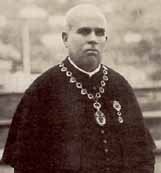
Personal Information
- Birth: September 29, 1863, Funchal, Santa Maria Maior
- Death: October 18, 1949, Funchal
- Citizenship: Portugal, Kingdom of Portugal
- Occupation: Priest, Professor, Historian, Writer
Biography
Born in 1863 in Santa Maria Maior, Funchal, son of Fernando Augusto da Silva and Joana Augusta de Freitas. He completed his studies at the high school and seminary, being ordained a priest in 1888. He served in various parishes in Madeira, eventually becoming the parish priest in Santo António do Funchal.
He was also a retired permanent teacher at the Escola Industrial e Comercial António Augusto de Aguiar in Funchal.
Died in Funchal in 1949, buried in the Cemetery of Santo António.
Public Service Commissions
- Procurator at the Junta Geral.
- Twice President of the Câmara Municipal do Funchal.
- President of the Santa Casa da Misericórdia.
- Member of several other commissions, contributing to writing reports, etc.
Journalistic Activity
- Editor of the newspapers Madeira, Diário de Notícias, and chief editor of Heraldo da Madeira.
- Contributed extensively to various other newspapers and magazines.
Associations
- Member of the Associação dos Arqueólogos Portugueses and Instituto Português de Arqueologia, História e Etnografia.
- Corresponding member of the Academia Portuguesa de História.
Honors
- Officer of the Order of São Tiago da Espada.
Published Works
- Elucidário Madeirense – 1921 - 1st edition in 2 volumes, 1940-46 – 2nd edition in 3 volumes. (in collaboration with Carlos Azevedo de Meneses, Adolfo César de Noronha, and Alberto Artur Sarmento).
- Paróquia de Santo António da Ilha da Madeira – 1929.
- A Lombada dos Esmeraldos na Ilha da Madeira – 1933.
- Dicionário Coreográfico do Arquipélago da Madeira – 1934.
- Camões e a Madeira – 1934.
- Dicionário corográfico do Arquipélago da Madeira -1934.
- Sé Catedral do Funchal – 1936.
- O Arquipélago da Madeira na Legislação Portuguesa – 1941.
- As Levadas da Madeira – 1944.
- Diocese do Funchal: Sinopse cronológica – 1945.
- Antiga Escola Médico-Cirúrgica do Funchal – 1945.
- A Antiga Escola Médico-Cirúrgica do Funchal - 1946.
- Subsídios para a História da Diocese do Funchal – 1946.
- O Revestimento Florestal do Arquipélago da Madeira – 1946.
- Colégio e Igreja de São João Evangelista do Funchal - 1947.
- João Gonçalves Zarco: traços biográficos – 1948.
- Vocabulário popular do Arquipélago da Madeira – 1950.
References
- CLODE, Luís Peter. Registo Bio-Bibliográfico de Madeirenses: Séc. XIX e XX. Funchal: Caixa Económica do Funchal, 1983
- Biographical note on Fernando Augusto da Silva on the Autores e Escritores da Madeira website
- References about the life and work of Fernando Augusto da Silva, by historian Alberto Vieira
5Credits
All credit for the encyclopaedia itself belongs to Fernando Augusto da Silva, Carlos Azevedo de Meneses and their collaborators. This digital edition was put together by Demeter Sztanko, an admirer of their work and of Madeira, who is grateful for every correction and suggestion sent to [email protected].
The edition also relies on the generosity of open data and open design: the maps and place locations are built on OpenStreetMap and its contributors, the Copernicus elevation model, the topographic maps of the Região Autónoma da Madeira (IRIG-Madeira), Natural Earth, GeoNames, the NGA GEOnet Names Server and Wikidata, and the text is set in Literata, Playfair and Sofia Sans Extra Condensed.
6Licence and disclaimer
The original work is in the public domain. Both authors of the Elucidário Madeirense died more than 70 years ago: Carlos Azevedo de Meneses in 1928 and Fernando Augusto da Silva in 1949. Under Portuguese and EU copyright law (life of the author plus 70 years), the 1921 edition and the 1940–1946 revised edition are free of copyright and may be used without restriction.
This digital edition is open source.
- The transcription and its corrections, the translations, summaries, chapter divisions, the knowledge base (people, places, chronology, links), the maps and the generated artwork are published under the Creative Commons Attribution 4.0 International licence (CC BY 4.0): you may share and adapt them for any purpose, provided you credit the “Elucidário Madeirense digital edition” and link to this site or the project.
- The software (pipeline and website) is released under the MIT licence.
- Source code, data and technical documentation: github.com/sztanko/elucidario_madeirense. Corrections and suggestions are welcome there as issues or pull requests.
Third-party data. Maps contain data © OpenStreetMap contributors (ODbL) and relief derived from the Copernicus DEM GLO-30 (© DLR e.V. 2010–2014 and © Airbus Defence and Space GmbH 2014–2018, provided under COPERNICUS by the European Union and ESA). IRIG-Madeira topographic data: NdD1 CC BY 4.0, NdD2 open data. GeoNames: CC BY 4.0. Natural Earth and the NGA GEOnet Names Server: public domain. Wikidata: CC0. Fonts: SIL Open Font License.
Disclaimer. This is not a facsimile. The text was extracted from digital copies of the printed volumes, corrected for OCR errors and lightly normalised, and the translations, summaries, notes and links were produced with the help of AI language models. Errors, omissions and inaccuracies are therefore possible, both from the original work (written in 1921–1940 and reflecting its time) and from this edition. Everything is provided “as is”, without warranty of any kind; the project accepts no liability for errors or for any use made of this material. For scholarly citation, consult the printed edition.