Maize (Zea mays)
Original title: Milho (Zea Mays)
Maize, an American grass introduced to Madeira after the older cereals, whose meal porridge fed two-thirds of the population; its cultivation was boosted in 1847 by Laureano da Câmara Falcão, yet most maize was still imported in 1921.
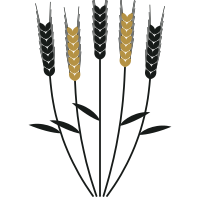
A grass originating in America, introduced to the island much later than wheat, barley and rye. Porridge made from maize meal is the staple food of two-thirds of the Madeiran population, and the grain is used to feed livestock and poultry. The panicle formed by the male flowers (the maize ‘tassel’, bandeira do milho) and the stalks and leaves of the plant can also be fed to cattle, while the bracts surrounding the female inflorescence are usually used to stuff mattresses. This inflorescence or spadix is called the maçaroca (cob); the barbas (silk) of the maize are the long styles or filaments at the end of the ovary.
Maize has long been grown in Madeira, but it was in 1847 that Laureano da Câmara Falcão, better known as the holder of the entail (morgado) of Ilha (a locality in the parish (freguesia) of São Jorge), developed its cultivation in the parishes of Santana (‘St Anne’) and São Jorge. For this purpose he brought over from the Azores several farmers, who taught here the growing methods used in that archipelago. The results he obtained from his undertaking were very gratifying, and to encourage maize growing among us the law of 22 July 1853 was passed, exempting local produce from the payment of tithes.
Maize production in the archipelago does not exceed 6,000 hectolitres, and some 11 million hectolitres have to be imported to meet consumption throughout the district (1921).
In this article
Time
Years mentioned · 03Place
Places mentioned · 05

Abroad
- America
Multiple countries. Continent of origin of maize.
America is recorded as the native region of maize, the tomato and the cockscomb amaranth, and as the probable origin of an insect studied by Professor Lounsbury. It was the source of pine seed given to the Funchal council in 1807 and the destination of the teacher Alexandre Luís da Cunha in 1828.
- Azores
Portugal. Origin of farmers brought to teach maize-growing methods.
The Azores, an Atlantic archipelago that shares plant species with Madeira. The Elucidário records settlement there by Madeiran families such as the Bettencourts, the 1801 ban on Azorean wines in Madeira, and imports of Azorean tobacco. It also notes that Azorean farmers were brought to Madeira to teach maize-growing methods.
- Ilha
Santana. Locality giving Laureano da Câmara Falcão his nickname, morgado da Ilha.
Ilha is an inhabited locality in São Jorge parish, encircled by a forking stream, and seat of an entail founded in 1559 on lands granted to Lopo Fernandes Pinto. It had a former Rosary chapel, gave Laureano da Câmara Falcão his nickname 'morgado da Ilha', and was served by a new levada branch built in 1938.
- Santana
Parish where maize cultivation was developed in 1847.
Santana is a parish on Madeira's north coast, praised as the most picturesque of the north. It was created from São Jorge in the 16th century, and the entry covers its settlement, parish priests, church, localities and population.
- São Jorge
Santana. Parish where maize cultivation was developed in 1847.
North-coast parish that was an original parish of Santana municipality and gives its name to the northern archpriest district. It is known for plant-fossil and lignite deposits studied by Heer and Bunbury, and for a 17th-century landslide. The Elucidário also describes its islet, headland, quay and stream.
People
People mentioned · 01-
Landowner known as the morgado da Ilha who in 1847 developed maize growing in Santana and São Jorge with Azorean farmers.