Garajau (cape)
Original title: Garajau (Cabo)
Entry on Ponta do Garajau, the headland closing Funchal bay to the east, named after the terns found there by the discoverers, and site of the 1927 Sacred Heart statue.
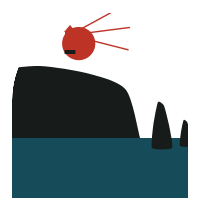


Referring to the discovery of this island and the first exploration along its coast, Gaspar Frutuoso says the following: ‘Having come to a high, great point, which the land thrust out, massive and sheer, into the sea, they found there so many common terns (garajaus) (sea birds), which without any fear settled on their heads and on the oars, that they took them by hand, at which they were much pleased and made great merriment. And for this reason the name Ponta do Garajau remained. . .’ This point forms the eastern end of the bay of Funchal. On rounding it, heading from east to west, the enchanting panorama of the city suddenly appears, climbing like an amphitheatre up the green slopes, the whole forming one of the most marvellous stretches of landscape a traveller could eagerly hope for. . . Ponta do Garajau rises 126 metres above sea level.
On one of its highest spots, at an altitude of about 120 metres and still within the bounds of the property that Councillor (conselheiro, honorary title of the royal council) Aires de Ornelas owned in the parish (freguesia) of Caniço (‘reed’), this distinguished Madeiran had a large statue dedicated to the Sacred Heart of Jesus (Sagrado Coração de Jesus) erected in 1927. Vessels sight it from a great distance as they make for the Port of Funchal (Porto do Funchal).
On this web-footed bird and the coastal point to which it gave its name, it is worth reading the series of articles that the distinguished naturalist Adolfo César de Noronha published in the Diario de Noticias of Funchal in December 1927.
In this article
Time
Years mentioned · 01Place
Places mentioned · 05- Garajau · Subject
Santa Cruz
Garajau is a headland closing Funchal bay to the east, 2.9 miles from Funchal, named after the terns found there by the discoverers. It is topped by a basalt dyke, bears a chapel of Nossa Senhora das Neves and the 1927 Sacred Heart statue, and had a telegraph from 1839 to 1847. It is noted for volcanic bombs, a surviving dragon tree, the only wild norça, Senecio incrassatus and deep-water shells, and is recommended as a viewpoint.
- Bay of Funchal
Funchal. The headland is its eastern limit.
The Bay of Funchal, between Ponta do Garajau and Ponta da Cruz, is the widest bay in the archipelago and the island's main anchorage, whose exposure to southerly gales caused many wrecks. The Elucidário notes it was surveyed by Vidal in 1843, that the Surprise was torpedoed there, and that it had never been studied oceanographically.
- Caniço
Santa Cruz. Parish where the statue stands.
Caniço is a parish in the municipality of Santa Cruz, lying on the boundary between the captaincies of Funchal and Machico. Its early settlers included Gaspar Rego, Vasco Fernandes Rego and Álvaro de Ornelas, whose family founded morgados there; its alcaide and judge were appointed by the Funchal senate. The parish includes the Garajau statue, the Jesuits' Socorro residence and the Quinta do Barão da Conceição.
- Harbour of Funchal
Funchal. Ships approaching it see the statue.
Funchal Bay, the largest harbour of the Madeira archipelago and the leading port of the Adjacent Islands. The islet lies at its western end, and it lies 4 miles from the port of Câmara de Lobos. The Elucidário gives its shipping statistics from 1901 to 1943 and records episodes such as corsair and warship visits.
- Ponta do Garajau
Santa Cruz. Subject of the entry, 126 m high.
A headland 126 m high marking the eastern limit of the bay of Funchal, on which the statue of the Sacred Heart of Jesus stands above the sea. It was a boundary of the Ornelas land grant, and the 100-fathom line lies only half a mile offshore there.
People
People mentioned · 03-
Naturalist who wrote articles on the tern and the headland in 1927.
- Aires de Ornelas1866–1930
Madeiran who erected the Sacred Heart statue on his Caniço property in 1927.
- Gaspar Frutuoso1522–1591
Chronicler quoted on how the headland was named at the discovery.