Cherne (Polyprion cernium)
The wreckfish, a prized deep-sea fish of Madeira, once abundant and large but becoming rarer through intensive fishing, mainly by Machico fishermen.
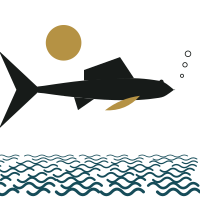
A fish of Madeira’s marine fauna, belonging to the family Serranidae, which local people consider one of the best-tasting fish to appear on the market. Once common, it is now becoming rarer because of the intensive fishing to which it has been subjected. Besides being abundant, specimens weighing 25 kilograms were not uncommon, and there were some, though rare, that weighed 50 and even more. It is the fishermen of Machico who chiefly devote themselves to this fishery, using the cherriola (vertical multi-hook deep-water line), which they lower to a great depth – from some 150 to 450 braças. The adults live exclusively in the abyssal zone; the young, however, roam the surface of the sea in shoals, often following a floating wooden beam or the wreckage of some shipwreck. That is why these young fish are usually called cherna de pau, and they are known as charnota if they weigh less than about 5 kilograms. In Madeira this fish is generally called cherna, a name given to another species on the coasts of Portugal, where the Madeiran cherne also exists and is known there by this latter name.
In this article
Place
Places mentioned · 02

Abroad
- Machico
Its fishermen specialise in wreckfish fishing.
The parish of Machico was the landing place of the discoverers Zargo and Tristão Vaz and the seat of the captaincy of Machico; the parish was founded c. 1450. The Elucidário covers its clergy and stipends, chapels, historical events, mineral springs, localities, population and notable natives.
- Portugal
On its coasts the names cherne and cherna apply differently.
Portugal, the mother country of Madeira. The Elucidário notes that artillery detachments were sent from the mainland to garrison Madeira before 1877, that Madeira was linked to Portugal by telegraph cable in 1874, and that woad and gifts of honey were formerly sent there from the island. Mainland oranges and olives are compared favourably with those of Madeira and Porto Santo.