Sugar-cane borer
Original title: Bicho da cana
The sugar-cane borer (larva of Nonagria sacchari) damaged Madeira's cane fields from at least 1502 until an introduced ant largely eliminated it from about 1887.
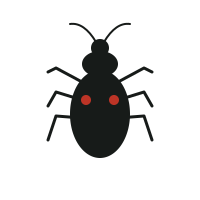
It is the larva of Nonagria sacchari, an insect of the order Lepidoptera. As early as 1502 this larva was devastating Madeira’s sugar plantations: on 15 November of that year a royal letter (carta régia) was sent to the judges and councillors (vereadores) of the Funchal Municipal Council (Câmara Municipal do Funchal), recommending the use of ash to destroy the cane borer. On 29 June 1509 a further royal letter announced the arrival on this island of one Fernão Rodrigues, charged with providing a remedy ‘to kill the grub that infests the canes... from which so much loss and damage follows’, and recommending that this Fernão Rodrigues be lodged and rewarded as the services he came to render deserved.
Despite these measures, it was only around 1887 that the cane borer began to disappear, owing to the relentless war waged on it by Iridomyrmex humilis, a species of ant imported from Demerara. Before this ant was introduced to Madeira, purely by chance, growers used to light torches and walk with them at night through the land planted with cane, so that the insect would fall onto the flame and die.
The larva of Nonagria sacchari lives inside the cane stalks, where it bores galleries that open to the outside. The walls of the galleries harden, and the adjacent tissues turn reddish and quickly begin to ferment. It appears mainly in summer, but since the introduction of the ant it has been rare on the island of Madeira.
In this article
Time
Years mentioned · 03Place
Places mentioned · 02

Abroad
- Demerara
Guyana. Origin of the ant Iridomyrmex humilis that controlled the pest.
Demerara, in British Guiana, received mass Madeiran emigration from about 1840, including emigrants after 1846, and was the main export market for Madeiran onions. The Elucidário also records it as the source of the dwarf banana, of entire-leaved sweet potatoes (1845) and of the ant Iridomyrmex humilis, and as the place where Alípio Augusto Ferreira edited O Portuguez.
- Funchal
Its council received royal letters on fighting the pest.
The capital of the archipelago and seat of the principal captaincy, where settlement began; it was made a vila c.1451–52. Its bay, the widest in the archipelago, lies between Ponta do Garajau and Ponta da Cruz and offers sheltered anchorage, though its harbour had never been studied oceanographically. The Elucidário discusses it as a health resort with climate data and records the January 1906 disturbances, the Danish prince's visit in May 1846 and recent volcanic cones in the area.
People
People mentioned · 01-
Man sent by royal order in 1509 to Madeira to find a remedy against the sugar-cane borer.