Parrotfish (Scarus cretensis)
Original title: Bodião (Scarus cretensis)
The parrotfish (bodião), a common and highly prized coastal fish of the Madeiran archipelago, with notes on its colour forms, habits and methods of capture.
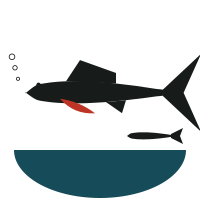
A fish of the family Labridae, common on the coasts of all the islands of this archipelago, including the Savage Islands (Selvagens), and rightly prized for its delicate flavour. It is a handsome species whose colour, which varies greatly, can range from dark slate flecked with lighter tones to brilliant red, while some individuals are red and grey at the same time. Hence the distinction that some fishing communities make between the brown, the red and the cardão parrotfish. It is not a migratory fish, but its somewhat nomadic habits lead it to move about the shallows near the coast. Although it is not as common as it once was, it is nevertheless one of the few coastal species that have managed to escape relatively lightly from the destructive effects of the senseless and ruinous practice of fishing with explosives.
It is caught from the water’s edge down to 30 braças, using, besides hook tackle, drag nets and set nets, the scoop net (peneiro) and the fish trap (covo); the rod, however, is the tackle preferred by amateur anglers and professional fishermen alike. As bait they usually use the jaca (local name for small shore crabs) or the aranha, crustaceans found under the stones of the shore between the tide marks.
Off the coast of the Desertas (‘deserted islands’), the fishermen of Caniçal (‘reed bed’) sometimes make large catches of this fish, which, after being split and salted, is brought to the Funchal market, though somewhat lowered in value by the salting.
In this article
Place
Places mentioned · 04

 1
1 - Caniçal
Machico. Home of the fishermen who fish for it off the Desertas.
Isolated fishing parish at the eastern tip of Madeira, at the root of Ponta de São Lourenço. It originated as a Moniz entail and João Teixeira's hunting reserve and became a parish around 1561. It holds a Piedade feast with a boat procession and has a fort built after a pirate raid.
- Desertas
Santa Cruz. Fishermen from Caniçal catch the fish in abundance off their coast.
An island group near Madeira that was already separated from it at the last eruptions and shares endemic species with it. It was the main orchil-harvesting area, and Wollaston found 89 beetle species there. The islands were investigated by scientific expeditions, including the Endurance scientists in 1914.
- Funchal
The salted fish is sold at the Funchal market.
The capital of the archipelago and seat of the principal captaincy, where settlement began; it was made a vila c.1451–52. Its bay, the widest in the archipelago, lies between Ponta do Garajau and Ponta da Cruz and offers sheltered anchorage, though its harbour had never been studied oceanographically. The Elucidário discusses it as a health resort with climate data and records the January 1906 disturbances, the Danish prince's visit in May 1846 and recent volcanic cones in the area.
- Savage Islands
Funchal · Selvagens. The fish is common even around the Selvagens islands.
A small uninhabited island group, politically part of the Madeira archipelago. The Elucidário covers its geography, geology, fauna, ownership history and legends of hidden treasure, including Shackleton's treasure plans, and notes the annual hunting of shearwaters and rabbits. It is the only remaining home of the limpet Patella vulgata and was studied by naturalists such as Lowe and Garreta.