Ilhéu Chão
The Ilhéu Chão is the smallest and flattest of the three uninhabited Desertas islands, separated from the Ponta de São Lourenço by a channel of some twenty kilometres. It is the only known home of the endemic grass Lolium lowei, and like the other Desertas it belonged to the captains of Funchal.
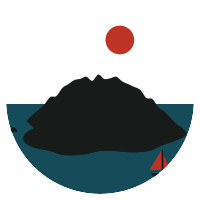


It is 1,852 metres long and 617 metres across at its widest point, and it owes its name, Ilhéu Chão (Flat Islet), to its flat top. Like the other two Desertas (‘deserted islands’), it is uninhabited, and its highest point stands 98 metres above sea level. It is separated from the Ponta de São Lourenço by a channel a little over twenty kilometres wide, through which ships of every size can sail.
Lolium lowei, a grass peculiar to the archipelago, has so far been found only on the Ilhéu Chão.
The three Desertas ‘are all an entail (morgado) of the Captains of the Jurisdiction of Funchal, says Frutuoso, from which it may be gathered that the glory of this discovery is owed to them; for although these islands lie opposite Machico, and very close to it compared with Funchal, the captains of Machico never had jurisdiction, possession or ownership of them, for they all belong to the Captains of Funchal: for which reason their descendants style themselves lords of them, as I have already said’. See Chão (islet), I-269, and Deserta Grande (‘great deserted island’) and Desertas, I-356 and 357.
In this article
Place
Places mentioned · 06- Ilhéu Chão · Subject
Santa Cruz · Desertas. The subject of the entry, a flat-topped islet of the Desertas.
The Ilhéu Chão is the smallest, flattest and northernmost of the three uninhabited Desertas islands, 93 m high and 19 miles from Funchal to its landing at the porto de Santa Maria. It is the only known home of the endemic grass Lolium lowei, and it once belonged to the captains of Funchal.
- Deserta Grande
Santa Cruz · Desertas. Given as a cross-reference for the Desertas group.
The largest island of the Desertas, 490 m high, seasonally visited by hunters, fishers and orchil gatherers. The steamer Lagos ran aground there in 1902, and it was visited by the Prince of Monaco in 1888 and by the Dana scientists. Its landing at Carga da Lapa is 21.5 miles from Funchal.
- Desertas
Santa Cruz. The island group to which the Ilhéu Chão belongs.
An island group near Madeira that was already separated from it at the last eruptions and shares endemic species with it. It was the main orchil-harvesting area, and Wollaston found 89 beetle species there. The islands were investigated by scientific expeditions, including the Endurance scientists in 1914.
- Funchal
The captaincy whose captains owned the Desertas.
The capital of the archipelago and seat of the principal captaincy, where settlement began; it was made a vila c.1451–52. Its bay, the widest in the archipelago, lies between Ponta do Garajau and Ponta da Cruz and offers sheltered anchorage, though its harbour had never been studied oceanographically. The Elucidário discusses it as a health resort with climate data and records the January 1906 disturbances, the Danish prince's visit in May 1846 and recent volcanic cones in the area.
- Machico
The captaincy facing the Desertas, which nevertheless never held them.
The parish of Machico was the landing place of the discoverers Zargo and Tristão Vaz and the seat of the captaincy of Machico; the parish was founded c. 1450. The Elucidário covers its clergy and stipends, chapels, historical events, mineral springs, localities, population and notable natives.
- Ponta de São Lourenço
Machico. The eastern point of Madeira, separated from the islet by a navigable channel.
The Ponta de São Lourenço is the long, narrow eastern headland of Madeira in the parish of Caniçal, said to be named after the caravel São Lourenço, with a lighthouse on its islet. The Elucidário describes its geology, seasonal vegetation, islets, fossil calcareous bodies at Piedade, land snails and use as pasture. The steamer Forerunner sank there in 1884, and a submarine bank lies between it and the Desertas.
People
People mentioned · 01- Gaspar Frutuoso1522–1591
Azorean chronicler quoted here saying that the Desertas were an entailed estate of the captains of Funchal.