Locusts
Original title: Gafanhotos
Locusts occasionally reach Madeira from Africa; the only serious plague recorded was in October 1844, when they stripped foliage on Madeira and Porto Santo.
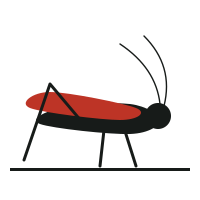
Every so often a few locusts from the African coast appear in Madeira, but the only real damage these insects have caused on record was in October 1844. For two or three days the locusts traced an ellipse in the air 5 to 6 kilometres across, settling in the afternoon on the trees and other plants, whose foliage they destroyed.
The locusts vanished as quickly as they had come, but for several days large numbers of them could be seen floating in the waters of the bay of Funchal and off Porto Santo (‘holy harbour’). ‘The Municipal Council (Câmara Municipal) of Porto Santo,’ say the Anais of that island, ‘passed a resolution (acordam) ordering each inhabitant to deliver one alqueire (dry measure for grain; as a land measure c. 900 m²) of those insects to the secretary of the said Council, João António Pedroso, and in this way within a few days 360 alqueires of that monstrous plague were buried.’
The locusts that invaded Madeira and Porto Santo at the end of October 1844 belonged to the species Dectycus albifrons, which has since been seen several times in Funchal.
In this article
Time
Years mentioned · 01Place
Places mentioned · 03


- Bay of Funchal
Funchal. Dead locusts were seen floating in its waters after the 1844 plague.
The Bay of Funchal, between Ponta do Garajau and Ponta da Cruz, is the widest bay in the archipelago and the island's main anchorage, whose exposure to southerly gales caused many wrecks. The Elucidário notes it was surveyed by Vidal in 1843, that the Surprise was torpedoed there, and that it had never been studied oceanographically.
- Funchal
The species has since been seen occasionally in Funchal.
The capital of the archipelago and seat of the principal captaincy, where settlement began; it was made a vila c.1451–52. Its bay, the widest in the archipelago, lies between Ponta do Garajau and Ponta da Cruz and offers sheltered anchorage, though its harbour had never been studied oceanographically. The Elucidário discusses it as a health resort with climate data and records the January 1906 disturbances, the Danish prince's visit in May 1846 and recent volcanic cones in the area.
- Porto Santo
Island also struck by the 1844 locusts, where 360 alqueires were buried.
An island of the archipelago, settled alongside Madeira and forming one of the three captaincies. It has always constituted a single parish, dedicated to Nossa Senhora da Piedade, whose church was repeatedly sacked. The Elucidário records the Moorish pirate raid of 1617, its own Misericórdia and a rainwater channel built on this drought-prone island.
People
People mentioned · 01- João António Pedroso1800–1869
Secretary of the Porto Santo municipal council in 1844, to whom each inhabitant had to deliver an alqueire of locusts.